
 English
  Français
  Tiếng Việt
  Italiano
  Nederlands
  Türkçe
  Svenska
  Polski
  Română
  Latviešu
  한국어
한국어  Русский
  Español
  Deutsch
  Українська
  Português
  العربية
  Indonesian
  Čeština
  Suomi
Suomi  Eesti
Eesti  Български
  Dansk
Dansk  Lietuvių
  Bokmål
  Slovenčina
  Slovenščina
  Ελληνικά
  Magyar
  עברית
עברית 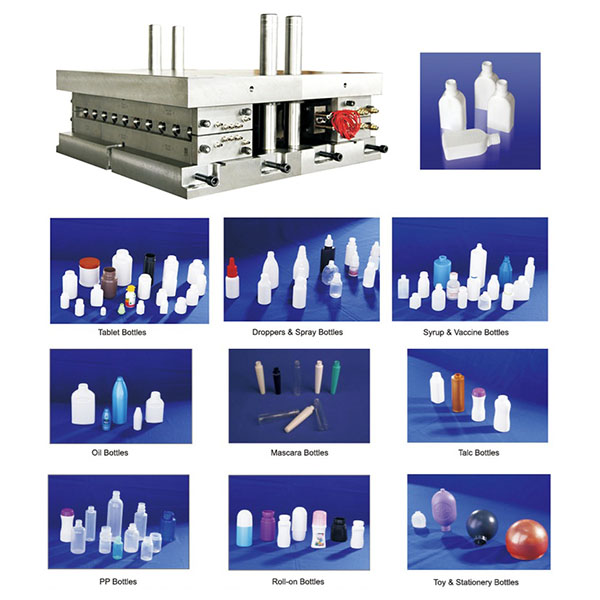
injection blow molding mould for PET bottles and closures
Injection blow molding molds are typically used to form neck-finished preforms, which are then blown in the mold cavity into the final container shape. They are suitable for pharmaceutical, cosmetic, food, chemical, and industrial small-bottle applications.
Description
Injection blow molding molds are used in one-step (injection-blow) or two-step processes to efficiently form hollow plastic containers and small hollow parts. Injection-blow molds balance dimensional stability, neck accuracy, wall-thickness uniformity, and production cycle times, and are compatible with a variety of engineering and commodity plastics.
Typical applications:
- Small pharmaceutical and healthcare bottles (medicine bottles, eye-drop bottles, spray bottles, etc.).
- Cosmetic and personal care containers (essential oil bottles, small perfume bottles, sample lotion bottles).
- Food and seasoning small bottles (sauces, small packaged oil bottles).
- Small industrial and chemical containers (lubricant bottles, reagent vials).
- Small hollow parts and sealed housings for special applications.
Product features and customer value:
- High neck and thread accuracy: finished neck geometry ensures cap fit and sealing performance, reducing leakage risk.
- Uniform wall thickness and high material utilization: by controlling preform design and blow parameters, target wall-thickness distribution is achieved and material waste is reduced.
- Good surface quality: suitable for glossy or fine-texture requirements, meeting coating, labeling, and decoration process needs.
- Fast and stable production cycle: mold and process coordination can deliver short cycles and high output, lowering unit production cost.
- Integrated or segmented flexibility: supports one-shot or two-stage processes for easy switching between different capacity and quality requirements.
Injection and blow process and mass-production flow:
- Trial molding and parameter verification: initial trials should validate injection molding stability, preform dimensions and temperature distribution, and the wall thickness and appearance after blowing.
- Preform injection control: adjust injection shot size, cooling time, and cavity temperature to ensure preforms meet dimensional and melt-state requirements prior to blowing.
- Transfer and blowing process: achieve smooth transfer from injection to blow, and set blow pressure, blow time, and cavity support parameters to obtain the target shape.
- Process locking: determine injection parameters, blow-pressure profile, mold temperature, and cycle timing; generate standard operating procedures (SOPs) and record key control points.
- Mass production and quality monitoring: use SPC to monitor wall thickness, neck dimensions, and appearance defects, combined with online vision and leak-testing to ensure consistency.
- Post-processing and packing: after trimming, coding or labeling, and functional sealing tests, proceed to packing and warehousing.