
 English
  Français
  Tiếng Việt
  Italiano
  Nederlands
  Türkçe
  Svenska
  Polski
  Română
  Latviešu
  한국어
한국어  Русский
  Español
  Deutsch
  Українська
  Português
  العربية
  Indonesian
  Čeština
  Suomi
Suomi  Eesti
Eesti  Български
  Dansk
Dansk  Lietuvių
  Bokmål
  Slovenčina
  Slovenščina
  Ελληνικά
  Magyar
  עברית
עברית 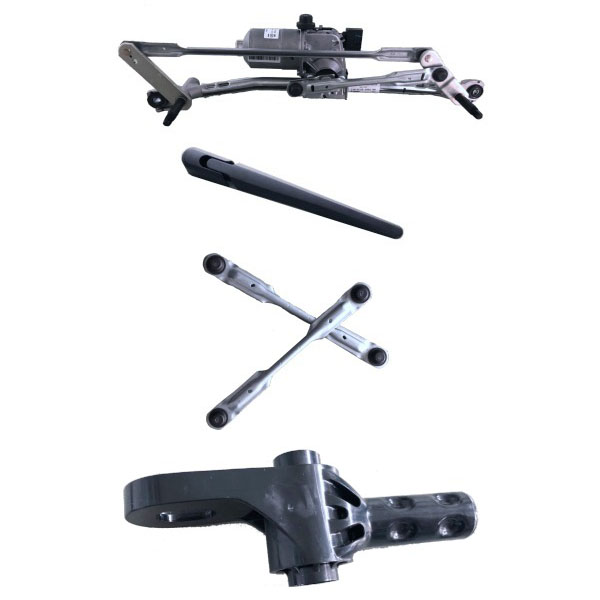
injection-molded inserts for automotive wiper systems
Injection-molded inserts for automotive wiper systems focus on providing high-strength, precisely located, corrosion-resistant, and mass-producible insert and overmolding solutions for automotive wiper mechanisms.
Description
Injection molding is suitable for wiper linkage ends, hinge bushings, bearing housings, fastening clips, end caps, metal pins, and various functional components that connect to wiper arms and motors. The products emphasize weather resistance, corrosion resistance, dimensional consistency, and long-term reliability, meeting the automotive industry’s stringent performance and durability requirements.
Applicable part types:
- Riveted inserts and metal sleeves: metal inserts for fastening and high-strength connections (such as copper bushings, stainless steel or galvanized steel sleeves).
- Bearings and bushings: low-friction, wear-resistant plastic bushings and transition pieces.
- Clips and quick-fit parts: quick-assembly clips and stops for wiper arms and linkages.
- Link end caps and end covers: end components that seal, waterproof, and maintain structural strength.
- Secondary overmolded assemblies: TPE/TPU overmolded parts for soft coverings to enhance sealing or reduce noise.
- Composite structural parts: metal-plastic integrated components (insert-molding) and two-color / two-shot molded parts (2K, 2-shot).
Mold and design key points:
- Insert positioning and clamping: The mold should incorporate precise insert clamping locations and positioning fixtures to ensure the insert position is stable and tolerances are controllable during each molding cycle.
- Thermal balance and cooling: Optimize cooling circuits according to the thermal conductivity of metal inserts to prevent local overheating or uneven cooling that could cause warpage or stress.
- Gating and overmolding strategy: Select appropriate gate locations and types (side gate, pin gate, or sub-gate/tunnel gate) to ensure good filling at the metal-plastic interface; use hot-runner systems when necessary to reduce scrap.
- Surface and contact design: Design thrust features or locking barbs at the insert–plastic contact surfaces to increase pull-out resistance.
- Venting and flow balance: Optimize venting channels and flow paths to avoid gas entrapment, burning, or short shots.
- Serviceability: Mold design should consider ease of insert replacement, mold maintenance, and core replacement.
Injection molding process and production flow:
- Insert pre-loading: Use automated feeding and positioning equipment to accurately place metal or prefabricated inserts into the mold; for small-sample runs, manual insert placement is possible but must ensure consistent positioning.
- Insert molding (IMI): Inject molten plastic into the mold with the insert fixed to form an integrated structure; strictly control injection speed, packing/holding, and hold time to reduce stress and ensure filling and bonding strength.
- Overmolding and secondary coating: For TPE/TPU overmolded parts, use secondary molding or 2K injection to achieve soft–hard combinations.
- Thermal treatment and cooling: Control cooling time and tempering processes according to material characteristics to reduce internal stress and deformation.
- Post-processing and secondary operations: Include deburring, ultrasonic cleaning, hot bending, painting, plating, or assembly pre-treatments (such as adhesive application or fastening).