
 English
  Français
  Tiếng Việt
  Italiano
  Nederlands
  Türkçe
  Svenska
  Polski
  Română
  Latviešu
  한국어
한국어  Русский
  Español
  Deutsch
  Українська
  Português
  العربية
  Indonesian
  Čeština
  Suomi
Suomi  Eesti
Eesti  Български
  Dansk
Dansk  Lietuvių
  Bokmål
  Slovenčina
  Slovenščina
  Ελληνικά
  Magyar
  עברית
עברית 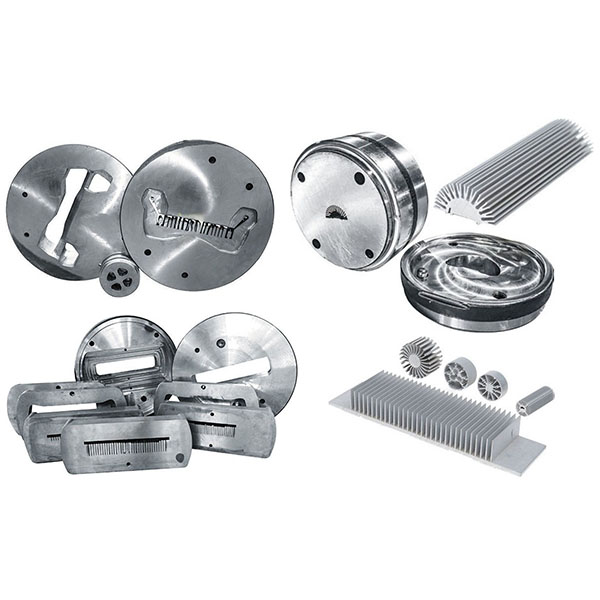
radiator profile extrusion die for thermal parts supply
The radiator profile extrusion die is specifically designed for the continuous, high-volume production of aluminum radiator and heat-sink profiles, with flow-channel and cavity optimizations tailored to the thin-wall, high-fin-density, and complex cross-section characteristics of thermal profiles.
Description
The radiator profile extrusion die can stably produce radiator profiles with precise dimensions, smooth surfaces, and excellent thermal conductivity in high-capacity extrusion environments, significantly reducing downstream machining and assembly adjustment costs.
Technical specifications:
- Applicable materials: aluminum (common alloys such as 6061, 6063, 6005, etc.), and aluminum-containing composite materials.
- Die material and treatment: typically tool steel die bodies with critical working surfaces subjected to heat treatment and surface strengthening (e.g., nitriding, coating, or shot peening) to improve wear resistance and anti-adhesion performance.
- Production mode: continuous extrusion forming combined with stretching, cooling, traction, and cutting operations, suitable for automated or semi-automated extrusion production lines.
- Accuracy and tolerances: high repeatability in cross-section dimensional control and fit tolerances can be achieved depending on profile complexity and aluminum alloy characteristics; specific tolerances will be confirmed based on drawings and process conditions.
- Service life and maintenance: die life is affected by aluminum alloy friction characteristics, production volume, and maintenance; proper operation, cleaning, and regular maintenance help extend service life and ensure stable production.
Main features:
- Optimized flow channels and cavities: designed specifically for aluminum melt/solid-state flow and cooling characteristics to reduce stagnation and internal stresses, lowering the risk of fin warpage and porosity.
- Precise cross-section control: high-precision die lips and cavity machining ensure geometric accuracy of fin spacing, thickness, and overall height, improving heat-transfer consistency and assembly fit.
- High wear resistance and anti-adhesion: critical contact surfaces undergo surface-strengthening treatments to effectively reduce aluminum sticking, surface roughness, and premature wear, decreasing downtime.
- Modular design and maintainability: supports insert-type, segmented, or replaceable module designs for rapid repair of fins, ribs, and other wear-prone parts, and for section modification or upgrades.
- Precision machining and integration: manufactured using high-precision processes such as CNC and EDM, combined with strict assembly and alignment workflows to ensure seamless interfacing with extrusion, traction, and cooling systems.
- Consideration of capacity and heat dissipation: die design balances thermal performance and production stability, optimizing cooling channel layout to increase production rates and reduce energy consumption.
Applications:
- Aluminum radiators and heat exchangers, HVAC radiator cores, and heat exchanger fins.
- Thermal management components for electronics and power equipment, such as radiator profiles, heat sink frames, and thermal rails.
- Automotive cooling system components, including water-cooled, oil-cooled, and HVAC radiator fins and guide profiles.
- Heat-dissipating profiles for LED and lighting applications, and power electronics thermal structures.
- Other production scenarios requiring high thermal conductivity and strict geometric accuracy for radiator profiles.