
 English
  Français
  Tiếng Việt
  Italiano
  Nederlands
  Türkçe
  Svenska
  Polski
  Română
  Latviešu
  한국어
한국어  Русский
  Español
  Deutsch
  Українська
  Português
  العربية
  Indonesian
  Čeština
  Suomi
Suomi  Eesti
Eesti  Български
  Dansk
Dansk  Lietuvių
  Bokmål
  Slovenčina
  Slovenščina
  Ελληνικά
  Magyar
  עברית
עברית 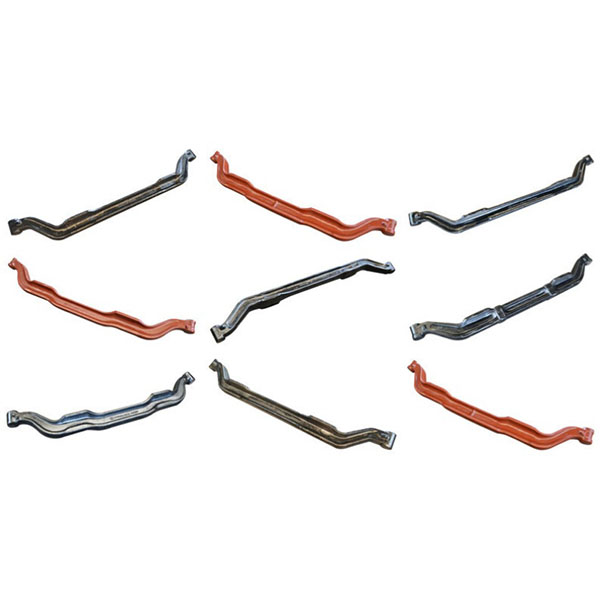
truck front axle forging engineered for reliable service
Truck front axle forgings are critical load-bearing and steering components manufactured by forging processes, with materials and structures optimized to meet the load-carrying and steering requirements of commercial vehicles.
The forging process ensures continuous metal fiber flow and a dense microstructure in the part, giving the front axle higher strength, toughness and fatigue resistance under axial, bending and impact loads, and making it suitable for medium- and heavy‑duty trucks, construction transport vehicles and special-purpose vehicles.
Manufacturing process:
- Forging forming: Closed-die or open-die forging is used to optimize metal flow, reduce internal defects, and improve microstructural density and mechanical uniformity.
- Heat treatment: Normalizing, quenching and tempering (quench + temper), carburizing, or localized induction heat treatment are applied according to material and service conditions to achieve the required surface hardness and core toughness.
- Precision machining: CNC turning, milling, grinding, deep-hole machining and gear machining are used to finish critical mating surfaces and steering joints, ensuring dimensional accuracy and interchangeability.
- Surface strengthening and protection: Optional processes such as shot peening, nitriding, induction hardening or carbonitriding can be used to improve fatigue life; sandblasting, phosphating, painting, electroplating or thermal spray coating are used for corrosion protection and appearance requirements.
Performance characteristics of truck front axle forgings:
- High load-bearing capacity: The forged structure combined with appropriate heat treatment significantly increases the part’s ultimate strength and static load capacity.
- Excellent fatigue resistance: Continuous metal fiber flow and reduced internal defects improve service life under cyclic loading.
- Strong impact and crack resistance: Parts are less prone to cracking or plastic failure under impact or sudden overload.
- High precision and easy installation: After precision machining, parts exhibit good dimensional stability and interchangeability, facilitating assembly and maintenance.
- Optimizable for operating conditions: Material selection, heat treatment and surface strengthening combinations can be used to achieve surface-to-core performance matching.
Applications:
Truck front axle forgings are widely used for front axles and their critical components in medium- and heavy‑duty trucks, tractors, construction transport vehicles, special-purpose vehicles and military vehicles, including spindles, steering knuckles, splined shaft ends, flange connectors, etc., and are especially suitable for service conditions with high safety and reliability requirements.