
 English
  Français
  Tiếng Việt
  Italiano
  Nederlands
  Türkçe
  Svenska
  Polski
  Română
  Latviešu
  한국어
한국어  Русский
  Español
  Deutsch
  Українська
  Português
  العربية
  Indonesian
  Čeština
  Suomi
Suomi  Eesti
Eesti  Български
  Dansk
Dansk  Lietuvių
  Bokmål
  Slovenčina
  Slovenščina
  Ελληνικά
  Magyar
  עברית
עברית 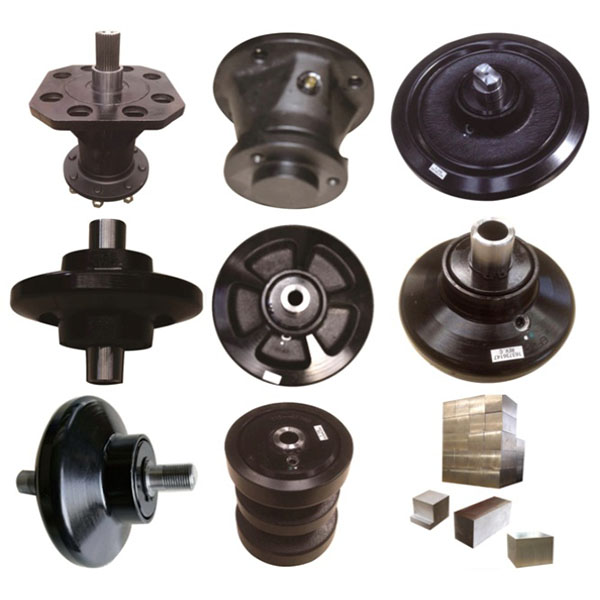
forged construction machinery parts for heavy duty use
The forged construction machinery parts are key transmission and load-bearing components produced by forging processes and feature a dense metallographic structure and excellent mechanical properties.
Compared with cast or welded components, forged components possess significant advantages in strength, toughness, fatigue resistance, and impact resistance, enabling construction machinery to achieve long-term reliable operation under high loads, impacts, and complex working conditions.
Materials and common part types:
- Common materials: carbon steels (e.g., 45#, A105), alloy steels (e.g., 42CrMo, 35CrMo, F11/F22, etc.), stainless steels (e.g., 304, 316), duplex steels or specialized wear-resistant alloys (e.g., low-alloy carburizing steels, quenched-and-tempered steels).
- Typical parts: pins, bushings, crankshafts, connecting rods, gears, wheel hubs, steering knuckles, track links, bucket teeth, connection plates, hydraulic cylinder end caps, etc.
- Certification support: material test certificates (MTC), chemical composition and mechanical property reports can be provided; third-party inspection and certification are supported.
Manufacturing process:
- Forging: open-die or closed-die forging is used, with control of forging temperature and deformation to ensure dense microstructure and continuous fiber flow.
- Heat treatment: normalizing, quenching and tempering, carburizing, or quenching and tempering (as appropriate to material and operating conditions) to achieve required hardness, toughness, and wear resistance.
- Machining: CNC precision turning and milling, grinding, gear cutting, deep-hole drilling, and multi-axis machining centers are used to machine critical dimensions and mating surfaces, ensuring interchangeability and assembly accuracy.
- Surface treatment: carburizing, nitriding, induction hardening, shot peening, chrome plating, phosphating, painting, etc., to enhance wear resistance, corrosion resistance, and fatigue life.
Performance features of forged construction machinery parts:
- High strength and high toughness with excellent impact resistance and load-bearing capacity.
- Outstanding fatigue and wear resistance, significantly extending part service life and maintenance intervals.
- High dimensional stability and geometric accuracy, facilitating assembly and interchangeability.
- Localized performance optimization can be achieved through heat treatment and surface strengthening, such as surface hardening while retaining core toughness.
Applications:
Forged construction machinery parts are suitable for various construction and heavy equipment, such as excavators, loaders, bulldozers, cranes, rollers, mining machinery, forestry equipment, etc., in scenarios involving high loads, repeated impacts, and complex working conditions. They are widely used in critical areas including undercarriage systems, working implements, steering systems, and drivetrains.