
 English
  Français
  Tiếng Việt
  Italiano
  Nederlands
  Türkçe
  Svenska
  Polski
  Română
  Latviešu
  한국어
한국어  Русский
  Español
  Deutsch
  Українська
  Português
  العربية
  Indonesian
  Čeština
  Suomi
Suomi  Eesti
Eesti  Български
  Dansk
Dansk  Lietuvių
  Bokmål
  Slovenčina
  Slovenščina
  Ελληνικά
  Magyar
  עברית
עברית 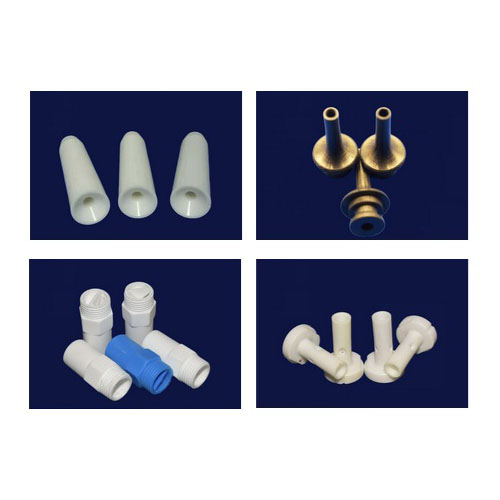
CNC machining of ceramic nozzles for spray precision
We provide professional CNC machining services for ceramic nozzles, focusing on the stable achievement of high‑precision bore sizes, excellent inner‑surface quality, and outstanding wear and corrosion resistance. Our products are widely used in precision spraying and atomization nozzles, fuel and injection system nozzles, spinnerets and nozzle heads, inkjet assemblies, industrial cooling and chemical spraying systems, and other scenarios requiring high levels of flow consistency and durability.
To address the high hardness and brittleness of ceramic materials, we achieve reliable machining of long slender through-holes, micro‑hole arrays, tapered bores, and complex nozzle geometries by optimizing process routes, using dedicated fixtures, and employing diamond‑based cutting tools.
Equipment and tooling:
- Machines and rigidity: Equipped with high‑rigidity CNC lathes, five‑axis and multi‑axis CNC machining centers, dedicated internal‑bore machining machines, precision grinders, and ultra‑precision spindles to ensure axial stability and repeatable positioning accuracy when machining small‑diameter high length‑to‑diameter ratio through‑holes and micro‑holes.
- Tools and consumables: Using diamond‑coated micro turning tools, diamond end mills, diamond internal‑bore grinding heads and diamond grinding wheels, as well as ultra‑fine abrasives and polishing consumables; we optimize tool geometry and cutting/grinding parameters for different ceramic materials to reduce chipping and cracking risks.
- Auxiliary systems: High‑precision spindles, vibration suppression systems, temperature‑controlled fixtures, ultra‑high‑pressure cooling and particulate filtration units, and online measurement and automated loading/unloading systems to improve throughput and consistency.
Main machining methods for CNC machining of ceramic nozzles:
- Precision drilling and boring: Used to form initial through‑holes and near‑net diameters, establish axial datums, and control coaxiality.
- Internal bore grinding and honing: Through diamond grinding, honing, and ultra‑fine grinding processes achieve strict diameter tolerances and low inner‑surface roughness, improving fluid flow uniformity and spray performance.
- Laser and ultrasonic assisted micro‑machining: Laser processing or ultrasonic vibration assistance can be used to improve cutting force distribution, reduce crack propagation, and machine micro features that are difficult to reach.
- EDM and micro‑machining trimming: For local forming and trimming of complex internal geometries, micro slots, and locating features.
- Polishing and chemical mechanical polishing (CMP): Apply mirror‑grade finishes to nozzle orifices and internal bores to reduce friction, prevent particle jamming, and optimize spray stability.
Cooling, chip evacuation, and fixturing:
- Cooling strategies: Use controlled cooling and highly filtered lubricants, combined with temperature‑controlled fixtures or coolant circulation systems to avoid thermal deformation and dimensional drift.
- Chip evacuation and cleaning: Optimize toolpaths and chip evacuation channels, and employ ultrasonic and high‑pressure cleaning, ultrasonic vibration chip removal, and vacuum cleaning processes to prevent particles embedding in internal bores that would affect spray consistency.
- Fixturing solutions: Custom internal mandrels, concentric locating fixtures, multi‑point supports, and elastic clamping designs to ensure stability and prevent deformation of long slender through‑holes and thin‑walled structures during machining.
Machinable materials and typical applications for CNC machining of ceramic nozzles:
- Machinable materials: Alumina (Al2O3), silicon nitride (Si3N4), silicon carbide (SiC), zirconia (ZrO2), coated ceramics and functional composite ceramics.
- Typical applications: Precision spray and atomization nozzles, fuel and injection system nozzles, spinnerets and nozzle heads, inkjet printing components, cooling and lubrication nozzles, chemical spray equipment nozzles, and specialized nozzle assemblies for high‑temperature, corrosive environments.
Processing accuracy and surface quality:
- Dimensional tolerances: By using stepwise roughing and finishing combined with online measurement, hole tolerances can be controlled at the micron level (depending on material and hole size); coaxiality and positional tolerances can be strictly controlled as required.
- Inner‑bore roughness: Through combinations of grinding, honing, and CMP, inner surfaces can achieve low Ra values to reduce particle adhesion and improve fluid dynamic behavior.
- Defect control: Optimize cutting parameters, perform staged stress relief, and apply necessary microscopic or non‑destructive testing (such as CT) to minimize cracks, chipping, and internal inclusions.