
 English
  Français
  Tiếng Việt
  Italiano
  Nederlands
  Türkçe
  Svenska
  Polski
  Română
  Latviešu
  한국어
한국어  Русский
  Español
  Deutsch
  Українська
  Português
  العربية
  Indonesian
  Čeština
  Suomi
Suomi  Eesti
Eesti  Български
  Dansk
Dansk  Lietuvių
  Bokmål
  Slovenčina
  Slovenščina
  Ελληνικά
  Magyar
  עברית
עברית 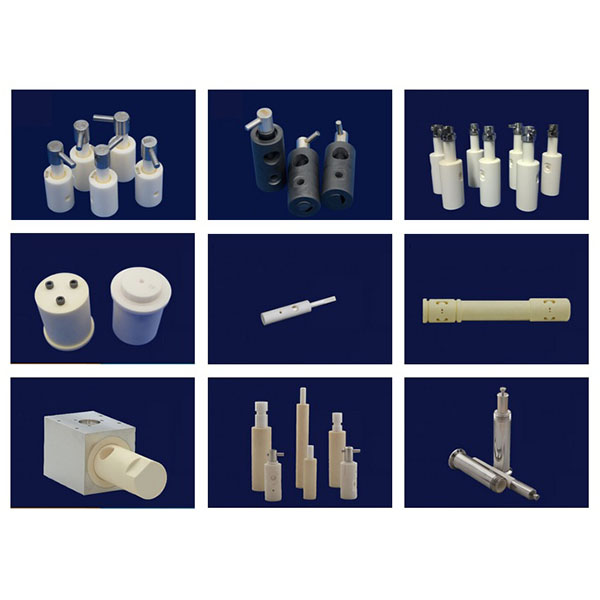
CNC machining of ceramic pumps for precision medical use
We provide professional CNC machining services for ceramic pumps, focusing on high-precision machining of key components such as pump bodies, impellers, valve seats, sealing surfaces, and flow channels.
Description
With specialized machinery, diamond tooling, and mature process flows, we can provide corrosion-resistant, wear-resistant ceramic pump component solutions with excellent sealing performance for applications such as chemical processing, pharmaceuticals, petroleum, semiconductors, food, and the transfer of high-temperature corrosive media.
Equipment and tooling:
- Machines and rigidity: We use high-rigidity five-axis and three-axis CNC milling machines, precision external cylindrical grinders, and specialized micro-machining equipment to meet the positioning and repeatability accuracy requirements for complex flow channels and multi-face machining.
- Tools and consumables: Using diamond end mills, diamond turning tools, diamond grinding wheels, and ultra-hard coated tools, we optimize tool geometry and cutting parameters for the hardness of ceramic materials to reduce chipping and cracking.
- Auxiliary equipment: High-precision spindles, ultra-high-pressure cooling and filtration systems, vibration suppression devices, and precision fixtures to ensure machining stability and surface integrity.
Main machining methods for CNC machining of ceramic pumps:
- Precision milling and sculpting: Used to form complex external shapes, flow channels, impeller blade profiles, and connection flanges, employing five-axis linkage to complete complex geometries in a single setup.
- Grinding and polishing: Diamond grinding and mechanical polishing processes are used to improve the finish and geometric accuracy of sealing surfaces and bearing surfaces.
- Ultrasonic vibration assisted machining (USM): Reduces cutting forces, limits crack propagation, and improves surface quality on brittle ceramic materials; suitable for slender or thin-walled structures.
- Micropore and internal cavity machining: High-precision machining of inlet/outlet ports, spray holes, and internal flow passages is achieved through micro-drilling, micro-grinding, or special guided processes.
- Chemical mechanical polishing (CMP) and precision grinding: Used to achieve mirror-grade sealing faces or contact surfaces with low friction coefficients to meet fluid sealing and low-wear requirements.
Cooling, chip evacuation, and fixturing:
- Cooling strategies: Use controlled cooling and filtered lubricants to reduce local heat buildup and prevent cracks or dimensional drift caused by thermal stress.
- Chip evacuation and cleaning: Design dedicated chip evacuation paths and efficient cleaning procedures to prevent abrasive particles or debris from embedding in sealing surfaces and flow channels, ensuring assembly integrity.
- Fixturing solutions: Custom rigid and flexible fixtures, concentric locating devices, and multi-point supports to ensure thin-walled and complex-shaped parts do not deform during machining.
Machinable materials and typical applications:
- Typical materials: Dense alumina (Al2O3), silicon nitride (Si3N4), silicon carbide (SiC), aluminum nitride (AlN), and functional ceramic composite materials.
- Typical applications: Corrosion-resistant pump bodies and heads, ceramic impellers, sealing sleeves, valve seats, bushings, fluid distributors, and components for high-temperature or highly corrosive fluid transfer systems.
Design recommendations and manufacturing considerations:
- Wall thickness and support: Avoid overly thin-wall structures or reserve machining support positions in the design stage to reduce the risk of breakage during machining and service.
- Fillets and transitions: Apply appropriate fillets in flow channels, through-holes, and edges to reduce stress concentration and facilitate machining and fluid performance optimization.
- Sealing and mating surfaces: Design critical sealing surfaces as polishable planes or cylindrical surfaces, and consider assembly gaps and surface roughness requirements.
- Modular design: For highly complex internal passages or deep cavities, consider machining separate modules and assembling them precisely to improve yield and facilitate later maintenance.